The Future is Hybrid: Why the Mix of Online and Campus Studies Stays
For a long time, there were only two camps: The "real" students who sat in the lecture hall, and the "distance learners" who pored over study letters alone. This strict separation is history.
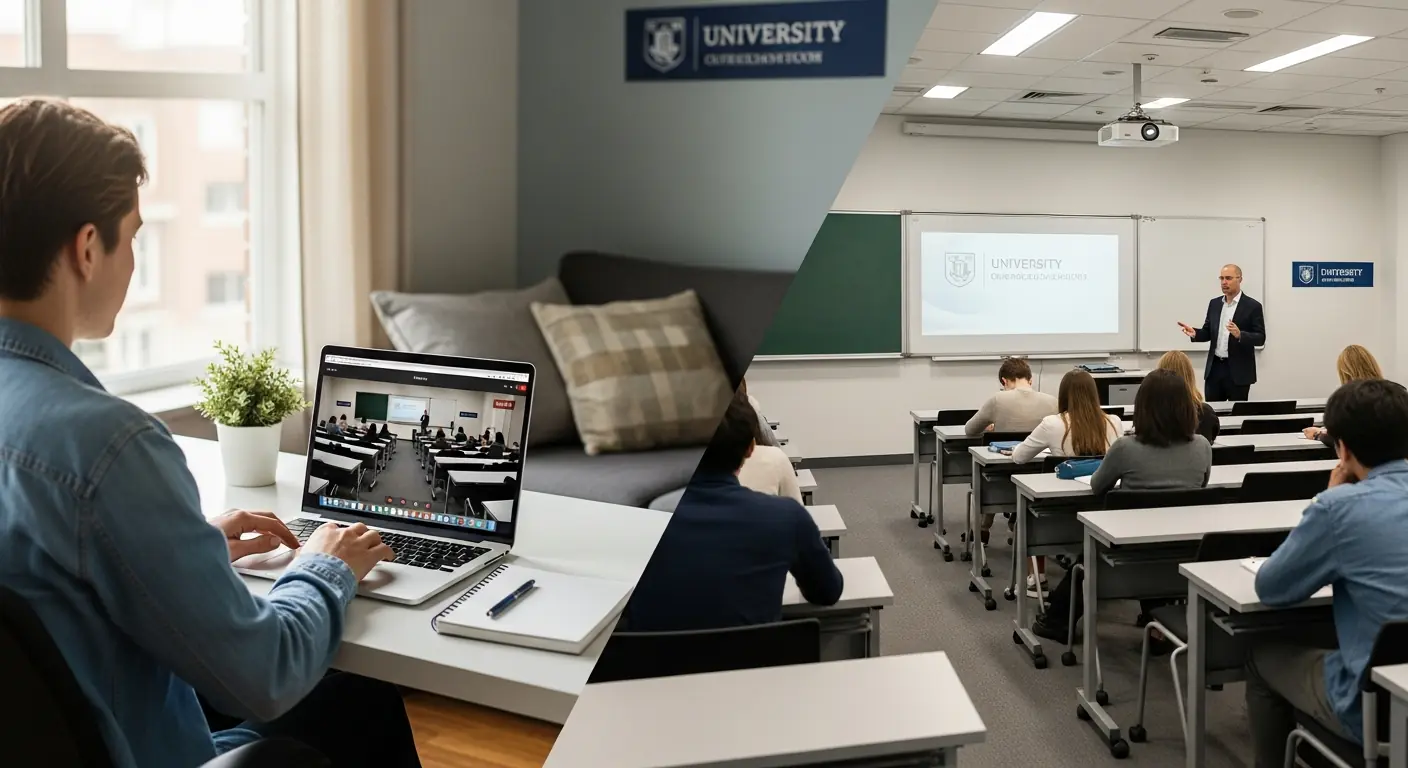
Online learning is no longer a stopgap solution but a permanent part of higher education. According to Global Market Insights (2026), the global e-learning market was worth around 250 billion USD in 2025 and could reach about 672 billion USD by 2035. For students, this means: The future is hybrid. Those who combine digital competence with in-person networking improve their career opportunities, especially since many employers accept online degrees: in a 2023 survey by the US association NACE, 87.4% of employers that record how their new hires studied had hired graduates with an online degree.
From Emergency Plan to Permanent Strategy
What many still remember as chaotic "Corona improvisation" (Emergency Remote Teaching) has developed into a professional megatrend. We are currently experiencing the "Unbundling" of the university.
In the past, everything took place on campus: lectures, studying, eating, partying. Today, the principle of intentionality applies:
- Campus becomes the social hub ("High Touch"): You go there to discuss, work in the lab, or network.
- Online tools become the knowledge hub ("High Tech"): You use them to learn facts, watch lectures, and do exercises.
The result: Digital and analog merge into powerful hybrid models that combine the best of both worlds ("Best of Both Worlds").
The Market Shows the Direction: Investments Follow Utility
Business doesn't lie. Where investment flows, that's where the future lies.
- Global Growth: According to Global Market Insights (2026), the market volume for e-learning will grow from around 250 billion USD in 2025 to about 672 billion USD by 2035 (forecast). This shows: The infrastructure is here to stay.
- Germany Catches Up: In January 2025, industry association Bitkom forecast for the German market as a whole (not only education) a 43% revenue jump for AI platforms to 2.3 billion euros and 12% growth for collaboration tools to 1.4 billion euros in 2025.
Interpretation: When universities and companies invest massively in software, they won't return to pure chalk-and-blackboard teaching.
What Students Really Want (The McKinsey Insight)
Are students just "lazy" and want to stay home? No, they're efficient. A McKinsey survey (2023) of more than 7,000 students in 17 countries clearly shows: almost 65% of students want aspects of their learning experience to remain virtual after the pandemic. At the top of their wish list: recorded classes to watch later, easy access to online study materials, and the flexibility to combine work and study.
The reasons are varied:
- Life-Balance: Hybrid models make it possible to balance studies, part-time jobs, and family.
- Learning Pace: Complex lectures can be paused and replayed online.
- Costs: Fewer commuting days mean lower travel costs and expensive cafeteria food.
Students aren't demanding the abolition of campus, but an enhancement of campus time. If I'm going to travel to university, I want interaction, not just listening.
The Career Turbo: Why Employers Love Hybrid Students
Here's the strongest argument for you. The work world has changed in parallel with universities. "New Work" today often means a mix of home office and office days. In NACE's survey of US employers (2023), 45% of new hires were in hybrid roles.
-
The Fit: Those who studied hybrid master this switch fluidly. They can self-motivate at home (online skill) and work in teams at the office (campus skill).
-
The Data: The US National Association of Colleges and Employers (NACE, Job Outlook 2024, survey from 2023) delivers impressive numbers:
- 87.4% of employers that record how their new hires studied have hired graduates with online degrees.
- All of these employers pay graduates with online degrees the same starting salary as graduates with in-person degrees.
-
A Possible Reason: Graduates who studied online already know digital tools (Slack, Zoom, Teams) and are used to organizing their own work.
What This Means for Your Study Strategy
The key is: The hybrid model is not an "either/or", but a clever combination.
The Ideal Hybrid Scenario:
- Monday & Tuesday (Online / Deep Work): You work through lectures asynchronously, read texts, and write papers. Full focus, no distractions.
- Wednesday (Campus / Socializing): You go to university for seminars, study groups, and coffee with fellow students. Here you recharge social energy and clarify open questions.
- Thursday & Friday (Practice / Job): You work as a working student, often also hybrid.
Our Practical Tips for Success
For the model to work, you need structure.
-
Cluster your presence: Try to schedule your campus courses on 1-2 days ("block days"). This saves travel time and creates large time blocks for deep learning at home.
-
Differentiate the locations: Study at home at a fixed place (not in bed!). Use campus specifically for group work. If you're just wearing headphones and watching YouTube on campus, you're doing it wrong.
-
Use the "Second Screen": When you're online in a live lecture, use the chat or digital whiteboards in parallel to stay active. Passivity is the enemy of online learning.
-
Digital Networking: Don't wait for the meeting in the cafeteria. Network proactively via LinkedIn or internal university chats. Digital contacts often lead to physical friendships.
-
Document your "Remote Skills": Write in your resume: "Experienced in working with virtual, international teams." This is now a hard skill.
Conclusion: You Are the Architect of Your Studies
Hybrid education is not a passing trend. It is the new standard of a digitalized society.
The question is no longer "Where do you study?" (location), but "How do you study?" (mode). Those who consciously use digital and analog formats are not only better prepared for the job market but also study more flexibly and often more cost-effectively. The mix makes the difference, and today you have the freedom to design this mix yourself.
Fuentes
Datos a fecha de: 5 October 2026
- E-Learning Market Size and Share Analysis, forecast 2026 to 2035, Global Market Insights, consultado el 16 October 2026
- Bitkom press release of 9 January 2025: German digital industry grows by 4.6 percent (forecast for AI platforms and collaboration tools), Bitkom e.V., consultado el 16 October 2026
- What do higher education students want from online learning? (survey of more than 7,000 students in 17 countries, 2023), McKinsey & Company, consultado el 16 October 2026
- Job Outlook 2024 (employer survey 2023, including online degrees and hybrid work), National Association of Colleges and Employers (NACE), consultado el 16 October 2026
Este contenido se ha creado con ayuda de IA, sobre todo en la investigación y la redacción previa. Revisión y aprobación por nuestra redacción.
Sobre el autor

Ramon Tissler
Founder & CEO
Ramon Tissler is the founder and CEO of StudyOnline.now. With over 25 years of experience in the education sector, he previously founded and led College Contact (1998-2020), a German education agency for international study programmes. His mission is to make finding the right online degree simpler, faster, and more accessible than ever before.