Learning "On the Go": Why Your Smartphone is the Better Library
It's a paradox: The device that distracts us the most (TikTok, Instagram, WhatsApp) is simultaneously a powerful educational tool. The smartphone is evolving from a pure communication device into a full-fledged learning tool.
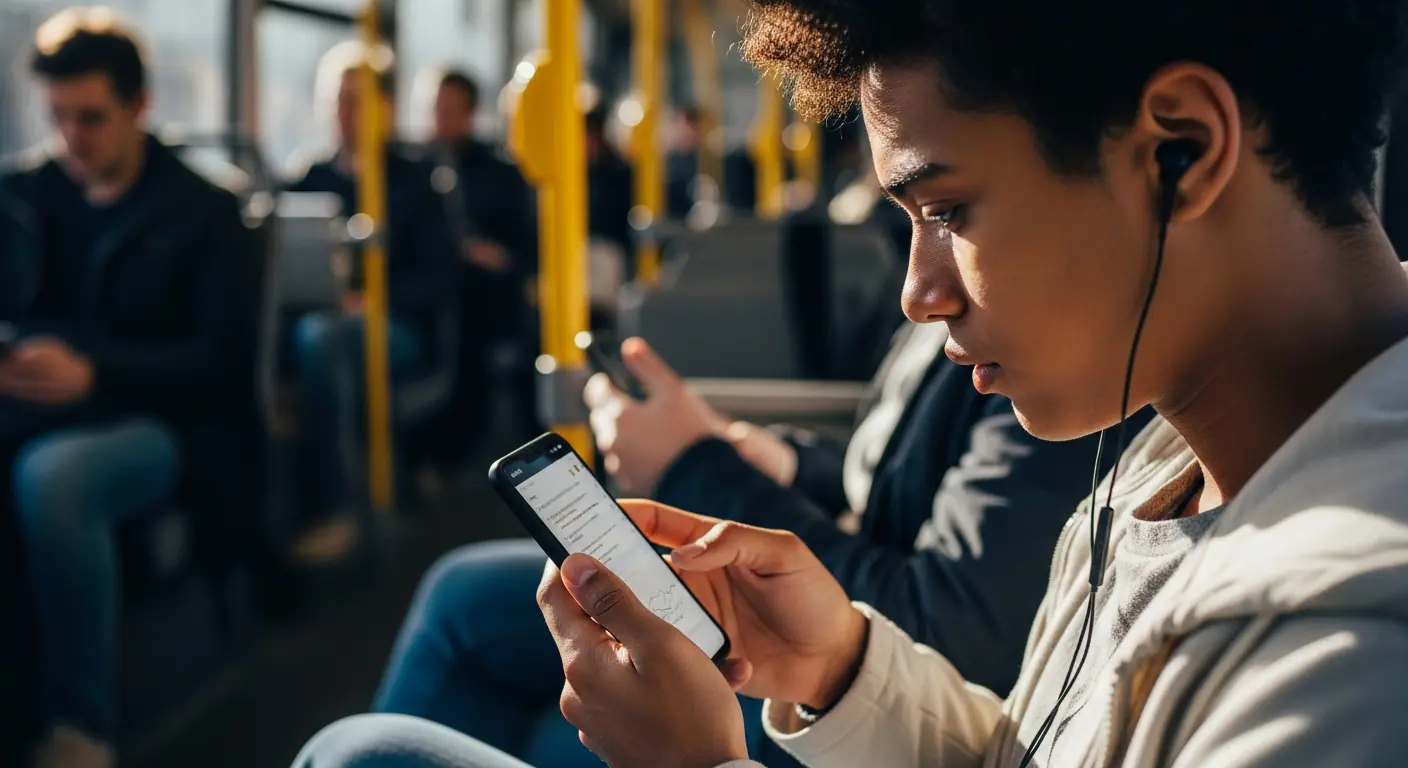
The market for "Mobile Learning" (mLearning) is growing rapidly: According to Mordor Intelligence (as of September 2026), it will grow from about 111 billion USD in 2026 to about 232 billion USD by 2031. The reason is not just convenience but a radical increase in efficiency: Learning in small bites ("Microlearning") adapts to our brain better than hours of cramming. We are witnessing the shift from "Second Screen" (supplement) to "First Screen" (primary learning location).
The Lecture Hall in Your Pocket: A Paradigm Shift
Just a few years ago, mobile learning was considered a nice supplement: reading a PDF on your phone when your laptop wasn't available. Today, mLearning is an independent pedagogical concept.
Technological developments (5G, high-resolution displays, cloud sync) have made it possible for complex content, from 3D anatomy models to interactive coding challenges, to run smoothly on 6 inches. The smartphone democratizes education: It's always with you, always on ("Always-on"), and lowers the barrier to start learning to just a few seconds.
The Science: Why Microlearning Hacks Your Brain
Why is learning on the subway often more effective than at your desk? The answer comes from cognitive psychology. Microlearning describes learning in short, focused units (nuggets), typically 3 to 10 minutes.
1. Fighting the Forgetting Curve
Hermann Ebbinghaus discovered the "forgetting curve" (1885): In his experiments with meaningless syllables, after just one hour without repetition he had to spend about half of the original learning effort again to relearn them.
- Stationary Learning: You study 3 hours once a week. By the next week, much is gone.
- Mobile Learning: You study 10 minutes every day. The high frequency of repetition breaks the forgetting curve. Knowledge moves from short-term to long-term memory.
2. Cognitive Load Theory
Our working memory is limited. A 90-minute lecture can easily lead to cognitive overload. Microlearning respects this limit. It serves only as much information as you can currently process. Learning research supports the principle behind it: In a large review, John Dunlosky and colleagues (2013) rated only two of ten common learning techniques as highly useful: distributed practice, meaning learning spread over several sessions, and practice testing.
Gamification: When Learning Becomes Addictive (In a Good Way)
Another reason for the mobile learning boom is gamification. Apps like Duolingo, Mimo, or Quizlet use similar psychological mechanisms to social media or gambling, but for a good purpose.
- Streaks: "You've been learning for 50 days in a row!" This triggers our desire not to break the chain.
- Instant Feedback: You solve a task and immediately get a "pling" and green color. This little dopamine kick motivates you to immediately tackle the next task.
- Leaderboards: Comparison with friends awakens the competitive instinct.
Market Development: A Market Worth Billions
The numbers illustrate the dimension:
- According to Mordor Intelligence (as of September 2026), the global mobile learning market will grow from about 111 billion USD in 2026 to about 232 billion USD by 2031. This corresponds to an annual growth rate (CAGR) of about 15.9%.
- Mordor Intelligence also names the spread of smartphones, tablets and laptops as a growth driver and expects companies to overtake academic institutions as a customer group by 2031. One trend it describes is "just-in-time learning" built into work tools: Instead of wading through manuals, employees watch, for example, a 2-minute video on their phone that solves their problem right away.
Transforming "Dead Time" into "Alive Time"
Author Robert Greene distinguishes between "dead time" (waiting, commuting) and "alive time" (using, learning). The smartphone is the key to reviving dead time.
The "Gap Time" Calculation:
- 15 minutes commuting to work/university
- 15 minutes return trip
- 10 minutes waiting (checkout, doctor, coffee)
- = 40 minutes per day
Calculated over about 240 working days a year, that is approximately 160 hours, equivalent to a complete month of full-time work (40-hour week) that you gain just through "in-between learning."
What Makes a Good Learning App (Your Tool Check)
The App Store is full of junk. How do you recognize an app that's actually good?
- Spaced Repetition System (SRS): Good apps (like Anki) show you a flashcard exactly when you're about to forget it. This builds on distributed practice, which learning research rates as highly effective.
- Offline Mode: Deutsche Bahn has dead zones. A good app must be fully functional in airplane mode so your learning flow doesn't break.
- Cross-Device Sync: You start in the morning on the train with your phone and continue in the evening on your laptop exactly where you left off.
- Bite-Sized Content: A 60-minute video on your phone is torture. Content must be modularly broken down into 5-minute chunks.
The Danger: The "Notification Trap"
Mobile learning has a natural enemy: The Instagram push notification that pops up at the top of your screen while you're learning. The strategy: You need to "weaponize" your smartphone.
-
Focus Mode: Set up a mode that blocks all social media apps during learning time.
-
Homescreen Design: Banish Instagram to page 3 in a folder. Put your learning apps (Audible, Kindle, Quizlet) on page 1. When you unlock your phone, learning should be the path of least resistance.
Conclusion: The Library in Your Pocket
Your smartphone is more than an entertainment device; it's a powerful learning tool when you configure it correctly. The mobile learning market is booming for a reason: The method is flexible, backed by learning research, and fits perfectly into hectic everyday life.
Those who use their smartphone cleverly transform waiting time into growth time. The sentence "I don't have time to learn" no longer applies, as long as you have time to wait for the bus.
Fuentes
Datos a fecha de: 7 October 2026
- Mobile Learning Market Size and Share Analysis, forecast 2026 to 2031, Mordor Intelligence, consultado el 16 October 2026
- Ebbinghaus (1885): Memory, A Contribution to Experimental Psychology, Chapter 7 (English translation 1913), Classics in the History of Psychology, York University, consultado el 16 October 2026
- Murre, Dros (2015): Replication and Analysis of Ebbinghaus Forgetting Curve, PLOS ONE, consultado el 16 October 2026
- Dunlosky et al. (2013): Improving Students Learning With Effective Learning Techniques, Psychological Science in the Public Interest (PubMed), consultado el 16 October 2026
- Cepeda et al. (2006): Distributed practice in verbal recall tasks, a review and quantitative synthesis, Psychological Bulletin (PubMed), consultado el 16 October 2026
- Anki Manual: Background on spaced repetition and active recall, Anki (ankiweb.net), consultado el 16 October 2026
- Robert Greene: Alive Time vs. Dead Time (The Knowledge Project, episode 35, 2018), Farnam Street (fs.blog), consultado el 16 October 2026
Este contenido se ha creado con ayuda de IA, sobre todo en la investigación y la redacción previa. Revisión y aprobación por nuestra redacción.
Sobre el autor

Ramon Tissler
Founder & CEO
Ramon Tissler is the founder and CEO of StudyOnline.now. With over 25 years of experience in the education sector, he previously founded and led College Contact (1998-2020), a German education agency for international study programmes. His mission is to make finding the right online degree simpler, faster, and more accessible than ever before.