Data Literacy as the New Basic Skill
Data Literacy is the new English. According to a Forrester study commissioned by Tableau (2022), decision-makers expected nearly 70% of employees to use data heavily in their jobs by 2025, up from 40% in 2018. For students this means: Whether you study art history, marketing, or sociology, the ability to read, interpret, and communicate data is no longer a "nerd thing" but a basic survival skill in the digital job market.

The End of "Gut Feeling"
For a long time, the assumption was: "I'm studying humanities because I don't want anything to do with math." This attitude is increasingly becoming a career risk. In a digitized world, decisions are no longer based on hierarchy or gut feeling, but on data ("Data Driven Decision Making").
According to a forecast by Allied Market Research for 2021 to 2030, the global market for big data analytics in education is projected to grow by an average of 15.3% per year. Today, employers expect an HR manager to use "People Analytics" and a journalist to master "Data Journalism."
Those who cannot read data are functionally illiterate in the 21st century. Data Literacy doesn't mean programming complex algorithms, but critically questioning the results of these algorithms and translating them into actions.
Not Calculating, But Understanding
The good news for all math skeptics: It's less about calculating and more about understanding. Modern tools (Low-Code/No-Code) take care of the mathematics for you. Your task is interpretation.
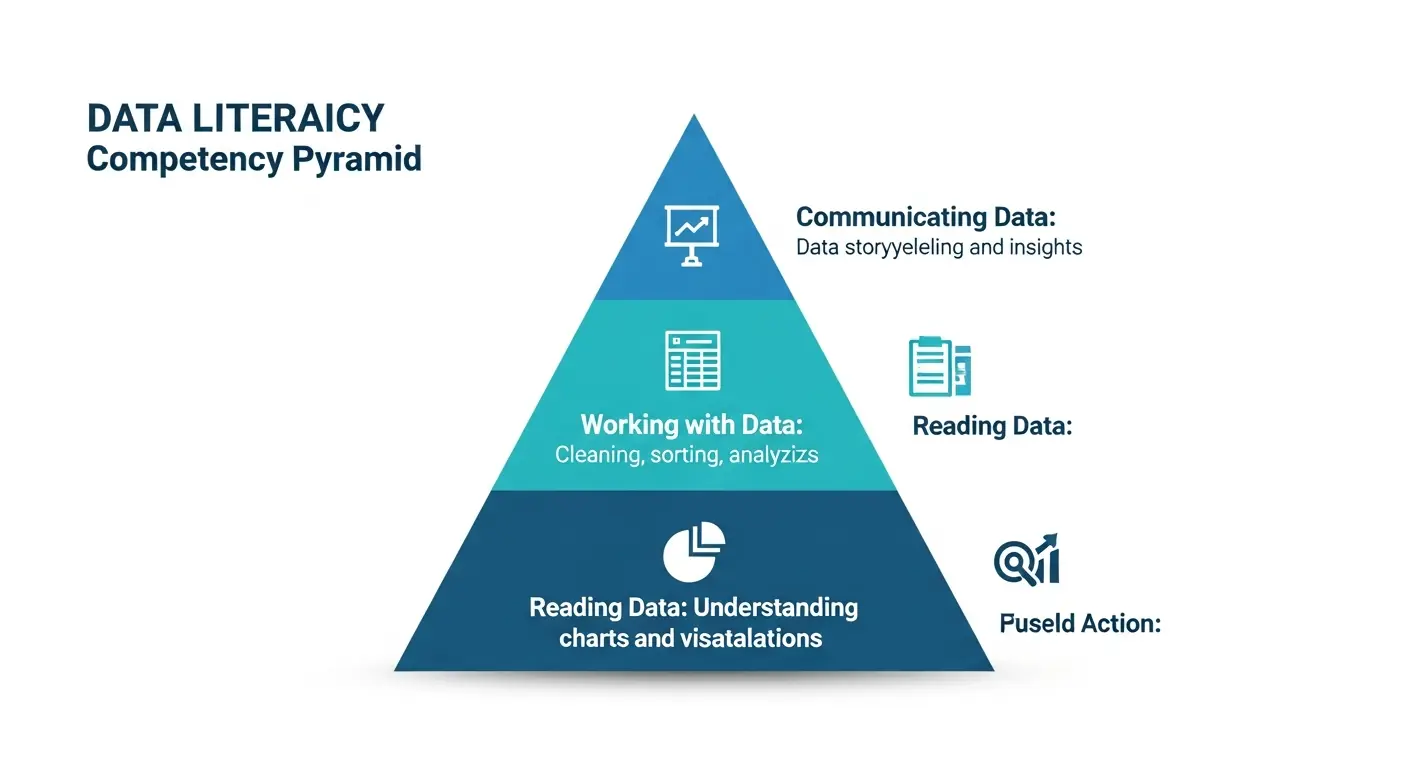
Three Levels of Data Literacy Required in Studies Today:
- Reading Data: Understanding what a chart says (and what it conceals)
- Working with Data: Cleaning, sorting, and managing data (e.g., in Excel or Airtable)
- Communicating with Data: Presenting results convincingly ("Data Storytelling")
Comparison: "Office Skills" vs. "Data Skills"
The requirements on resumes are shifting dramatically.
| Feature | Yesterday (Standard "Office") | Today & Tomorrow ("Data") |
|---|---|---|
| Word Processing | Microsoft Word | Markdown, Notion, collaborative docs |
| Tables | Excel (basic) | Excel/Sheets (Pivot, formulas), Airtable |
| Presentations | PowerPoint | Data visualization tools (Tableau, Power BI) |
| Research | Google Search | Database queries, data sourcing |
| Decision Making | Opinion/Experience | Data-driven insights |
Why Every Major Needs Data Skills
Marketing
- A/B testing analysis
- Customer segmentation
- Campaign ROI measurement
- Social media analytics
HR / Human Resources
- People Analytics
- Retention prediction
- Hiring funnel optimization
- Employee sentiment analysis
Journalism
- Data Journalism
- Fact-checking with data
- Visualizing complex stories
- Source verification
Social Sciences
- Statistical analysis
- Survey data interpretation
- Trend identification
- Policy impact assessment
What the Numbers Say
The data is compelling, and the trends are accelerating:
Gartner Findings and Forecasts (2024 and 2025):
- 83% of Chief Data and Analytics Officers (CDAOs) report that their organization has a data literacy program in progress or plans to deploy one within 12 months
- By 2027, more than 50% of CDAOs will secure funding for data literacy and AI literacy programs (Gartner forecast, January 2024)
- By 2027, 75% of hiring processes will include certifications and testing for workplace AI proficiency (Gartner forecast, October 2025)
- In Gartner's 2024 CDAO Survey, poor data literacy and other skills gaps are among the top 5 roadblocks to data and analytics success
World Economic Forum 2025:
- AI and big data is ranked #1 fastest-growing skill globally
- 39% of workers' skills will need updating by 2030
- 77% of employers plan to upskill their workforce in response to AI
The Cost of Data Illiteracy (Studies by Qlik and Partners):
- According to an Accenture and Qlik survey of 9,000 employees (published 2020), companies lose an average of 43 hours (more than 5 working days) per employee annually due to procrastination and sick leave linked to stress around data and technology
- In the same survey, 74% of employees said they feel overwhelmed or unhappy when working with data
- According to the Data Literacy Index commissioned by Qlik (2018), large enterprises with higher corporate data literacy have $320-$534 million (3 to 5%) higher enterprise value
- In a Qlik survey published in 2022, business leaders and employees predicted that data literacy will be the most in-demand skill by 2030
How to Build Your Data Literacy
- Start with basics: Learn to read charts critically: what's shown, what's hidden?
- Master spreadsheets: Excel/Sheets proficiency is the entry ticket
- Learn a visualization tool: Tableau, Power BI, or Looker Studio (formerly Google Data Studio)
- Practice data storytelling: Turn numbers into compelling narratives
- Take an online course: Many free resources and online learning platforms are available. Find the right one for you at StudyOnline.now
Tools You Should Know
For Beginners
- Google Sheets/Excel: Foundation for data work
- Looker Studio (formerly Google Data Studio): Free dashboard creation
- Canva Charts: Simple data visualization
For Intermediate Users
- Tableau Public: Professional visualization (free version)
- Power BI: Microsoft's analytics platform
- Airtable: Database-spreadsheet hybrid
For Advanced Users
- Python (Pandas): Data analysis programming
- SQL: Database querying
- R: Statistical analysis
The Democratization of Data
The barriers to data literacy are falling. You don't need a statistics degree to understand data. No-code tools, AI assistants, and intuitive interfaces make data accessible to everyone.
Your competitive advantage isn't being able to calculate statistics; it's being able to ask the right questions of data and communicate insights effectively.
Conclusion
Data Literacy is the new English, a basic skill expected across all professions. The good news: You don't need to become a data scientist. You need to become data-comfortable. Understanding charts, questioning numbers, and telling stories with data are skills anyone can learn. Those who start building these competencies during their studies position themselves for success in virtually any career.
Fuentes
Datos a fecha de: 14 October 2026
- Building Data Literacy: The Key to Better Decisions, Greater Productivity, and Data-Driven Organizations (Forrester Consulting study commissioned by Tableau, 2022), Tableau / Forrester Consulting, consultado el 16 October 2026
- Data Literacy: survey findings on CDAO programs and roadblocks, Gartner, consultado el 16 October 2026
- Gartner Predicts More Than 50% of CDAOs Will Secure Funding for Data Literacy and AI Literacy Programs by 2027 (press release, January 2024), Gartner, consultado el 16 October 2026
- Gartner Unveils Top Predictions for IT Organizations and Users in 2026 and Beyond (press release, October 2025), Gartner, consultado el 16 October 2026
- Future of Jobs Report 2025: 78 Million New Job Opportunities by 2030 but Urgent Upskilling Needed (press release), World Economic Forum, consultado el 16 October 2026
- New Research from Accenture and Qlik Shows the Data Skills Gap Is Costing Organizations Billions in Lost Productivity (2020), Accenture, consultado el 16 October 2026
- New Research Uncovers $500 Million Enterprise Value Opportunity with Data Literacy (Data Literacy Index, 2018), Qlik, consultado el 16 October 2026
- Big Data Analytics in Education Market: Global Opportunity Analysis and Industry Forecast 2021-2030, Allied Market Research, consultado el 16 October 2026
Este contenido se ha creado con ayuda de IA, sobre todo en la investigación y la redacción previa. Revisión y aprobación por nuestra redacción.
Sobre el autor

Ramon Tissler
Founder & CEO
Ramon Tissler is the founder and CEO of StudyOnline.now. With over 25 years of experience in the education sector, he previously founded and led College Contact (1998-2020), a German education agency for international study programmes. His mission is to make finding the right online degree simpler, faster, and more accessible than ever before.