Gamification & VR: When Studying Becomes a Game
For a long time, playing was considered the opposite of learning. "Stop gaming and do your homework!" was the standard phrase of many parents. But in 2025, this paradigm is turning 180 degrees.
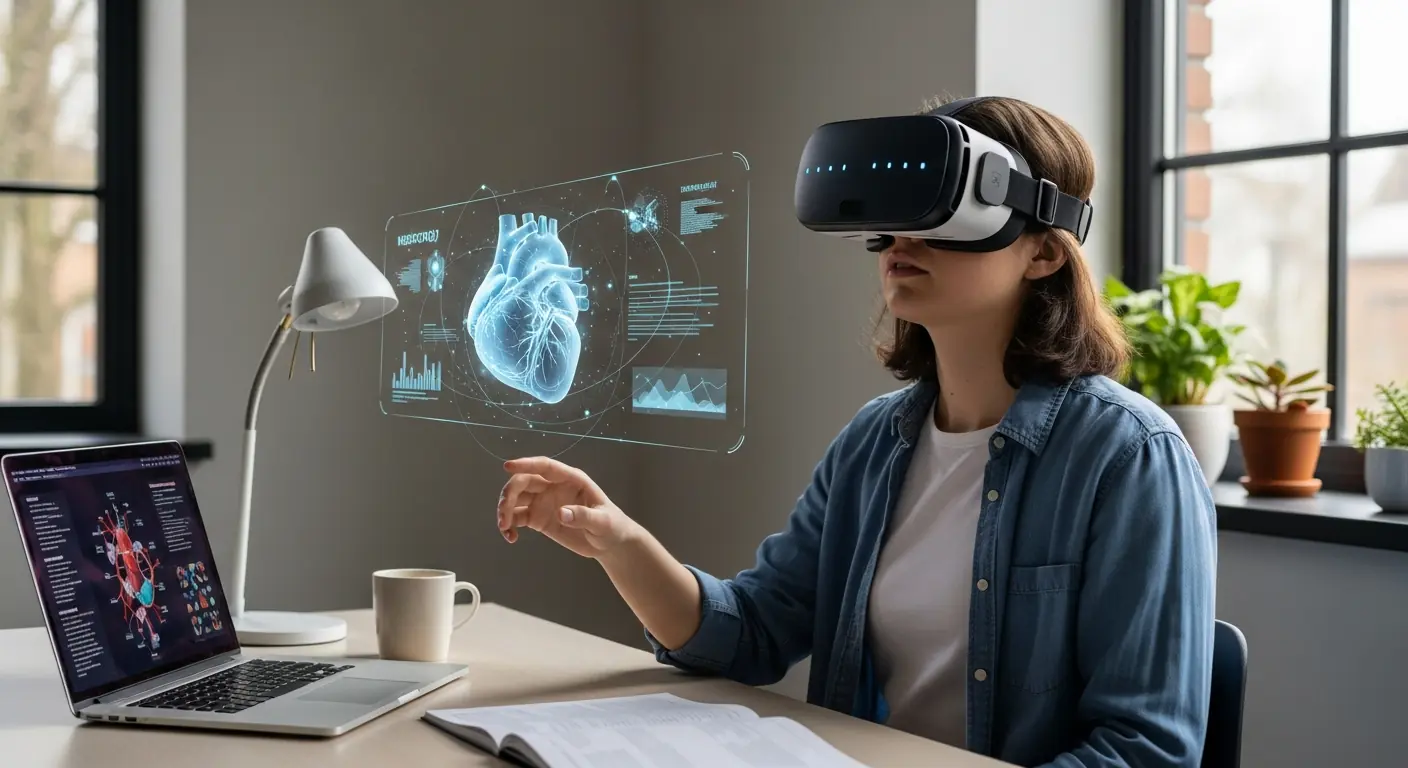
The use of game elements (gamification) and Virtual Reality (VR) is not a short-term hype but a serious way of learning. A study by PwC (2020) shows the potential: employees in a VR soft skills training completed it up to 4 times faster than colleagues in the classroom. We are witnessing the transition from the "Information Age" (reading knowledge) to the "Experience Age" (experiencing knowledge).
The Neuroscience of Gaming: Why Your Brain Loves XP
Why can gamers spend hours mastering a difficult level but give up frustrated after 20 minutes of math homework? The answer lies in neurochemistry.
Gamification doesn't use magic, but biological reward systems:
-
Dopamine Loops: When you defeat a monster in a game, your brain releases dopamine. It feels good. Learning platforms use this: A completed chapter gives immediate feedback ("Level Up!"). The brain connects "learning" with "reward."
-
The Flow State: Good games are designed to sit exactly at the boundary between "too easy" (boredom) and "too hard" (frustration). This is called the "Flow Corridor." Modern adaptive learning software does exactly this: It adjusts the difficulty of your tasks so that you always stay in flow.
-
Error Culture: In a game, "Game Over" just means "try again." In school, a failing grade means failure. Gamification removes the fear of making mistakes and encourages experimentation ("Trial and Error").
Market Development: From Niche to Billion-Dollar Market
Business has recognized that dry PowerPoint battles are inefficient.
-
The Volume: Market research firms expect strong growth, but their figures differ widely. According to Value Market Research (2026), the global education gamification market will grow from 3.24 billion USD in 2025 to around 31 billion USD in 2034, an annual growth rate (CAGR) of about 28.5%. Market.us (2025) uses a broader definition and puts the gamified learning market at 12.7 billion USD in 2024. These are estimates and forecasts, not facts, but they show the direction.
-
The Drivers: Platforms like Roblox and Minecraft Education are no longer just children's toys: market researchers such as Mordor Intelligence (2026) list them among the companies in the edutainment market. Tech companies are also bringing VR into education: since February 2025, Meta has offered Quest headsets with education apps and management features to teachers and trainers through its "Meta for Education" program.
VR Under Stress Test: The PwC Study (The "4-Times-Faster" Rule)
Perhaps the most important study on this topic comes from consulting firm PwC (2020). New managers at 12 US locations took the same training on inclusive leadership, either in the classroom, as e-learning, or in VR.
The results are almost shockingly clear:
-
Speed: VR learners completed the training up to 4 times faster than classroom learners. What took 2 hours in the classroom could be learned in about 30 minutes in VR. Even including the time needed to get started with the headset, they were still 3 times faster.
-
Focus: In VR, you're isolated. You can't look at your phone. VR learners were up to 4 times more focused than e-learners and 1.5 times more focused than classroom learners.
-
Confidence: The most important point. VR learners were up to 275% more confident in applying what they learned in reality afterward. Why? Because they didn't just read it, they did it.
Embodied Cognition: Learning with the Body
Why is VR so effective? The scientific concept behind it is called "Embodied Cognition." Our brain learns best when the body is involved.
- Traditional: You read in a book how a heart works (Abstract).
- VR: You stand in a heart chamber, see the valves beating, and have to repair them with your hands (Immersive).
The brain stores this VR experience not as "read information" but as "lived memory", similar to a real vacation. The idea behind it: what you have experienced yourself, you remember more easily.
Application areas today:
- Medicine: Surgeons practice complex operations on virtual patients. Mistakes are allowed here, not in real surgery.
- Soft Skills: You practice a termination conversation with a virtual avatar that reacts emotionally.
- History: You travel back to ancient Rome instead of just memorizing dates.
How Gamification Works in Studies (Mechanics vs. Dynamics)
One must distinguish between superficial gamification ("Pointsification") and real game design.
The Basic Elements (PBL):
- Points: Quantifiable feedback for every action.
- Badges: Symbols for special achievements ("Night Owl Badge" for learning after 10 PM).
- Leaderboards: Social comparison for competitive types.
The Deeper Elements (Dynamics):
- Narrative (Storytelling): The course is embedded in a story. You're not a "student," you're a "data detective" and have to solve a case (through statistics exercises).
- Social Quests: Tasks that can only be solved as a team (raid mechanics), which promotes collaboration.
Warning: "Chocolate-Covered Broccoli"
Not everything labeled as a game is good. Experts warn of the "Chocolate-Covered Broccoli" effect: If you just cover boring content (broccoli) with points (chocolate), it still doesn't taste good. Good gamification changes not just the packaging, but the learning process itself. When choosing your studies, pay attention: Are game mechanics used to promote real understanding, or just to artificially keep you engaged?
Our Practical Tips for You
How do you use this trend for your studies?
-
Look for immersive offerings: When choosing studies, specifically ask: "Do you use simulations or VR labs?" A university that says no might be training you for the past.
-
Use Consumer VR: Do you have a VR headset (e.g., Meta Quest)? Use apps like "Immerse" (language learning) or "Nanome" (molecular biology) to visualize your university material.
-
Gamify yourself: If your degree program is boring, use apps like Habitica. Here, your life becomes a role-playing game. Every completed task gives your avatar experience points.
-
Understand the "Skill Tree": View your studies like a talent tree in a role-playing game. Which skills do you need to unlock to reach the "Endgame" (your dream job)?
Conclusion: The End of Dry Exercises
Gamification and VR are far more than colorful gimmicks. They are the answer to the attention crisis in the digital age.
Market development suggests: In a few years, it could be normal to attend lectures with VR glasses or receive "Epic Loot" for solving statistics problems. As a student, you can benefit from faster learning success (up to 4 times faster in the PwC study), higher motivation, and, let's not forget, simply more fun. Learning doesn't have to hurt to work.
Sources
Information as of: 6 October 2026
- What does virtual reality and the metaverse mean for training? (PwC VR Soft Skills Training Efficacy Study, 2020), PwC US, accessed on 16 October 2026
- Global Education Gamification Market: size and forecast 2026 to 2034 (report summary), Value Market Research, über Global Information Inc., accessed on 16 October 2026
- Gamified Learning Market: size, share and forecast to 2034, Market.us, accessed on 16 October 2026
- Edutainment Market: size, share and companies (2026 to 2031), Mordor Intelligence, accessed on 16 October 2026
- New Meta for Education offering is now generally available (February 2025), Meta, accessed on 16 October 2026
This content was created with the help of AI, mainly for research and first drafts. Reviewed and approved by our editorial team.
About the Author

Ramon Tissler
Founder & CEO
Ramon Tissler is the founder and CEO of StudyOnline.now. With over 25 years of experience in the education sector, he previously founded and led College Contact (1998-2020), a German education agency for international study programmes. His mission is to make finding the right online degree simpler, faster, and more accessible than ever before.