Async vs. Sync: When You Should Skip the Livestream
The rigid schedule is dead. The future of learning is divided into two camps: "Self-Paced" (Asynchronous) for pure knowledge acquisition and "Live" (Synchronous) for exchange. According to Global Market Insights (2026), self-paced e-learning accounted for more than half of the global e-learning market in 2025. Understanding when to use which format means learning not more, but more efficiently.
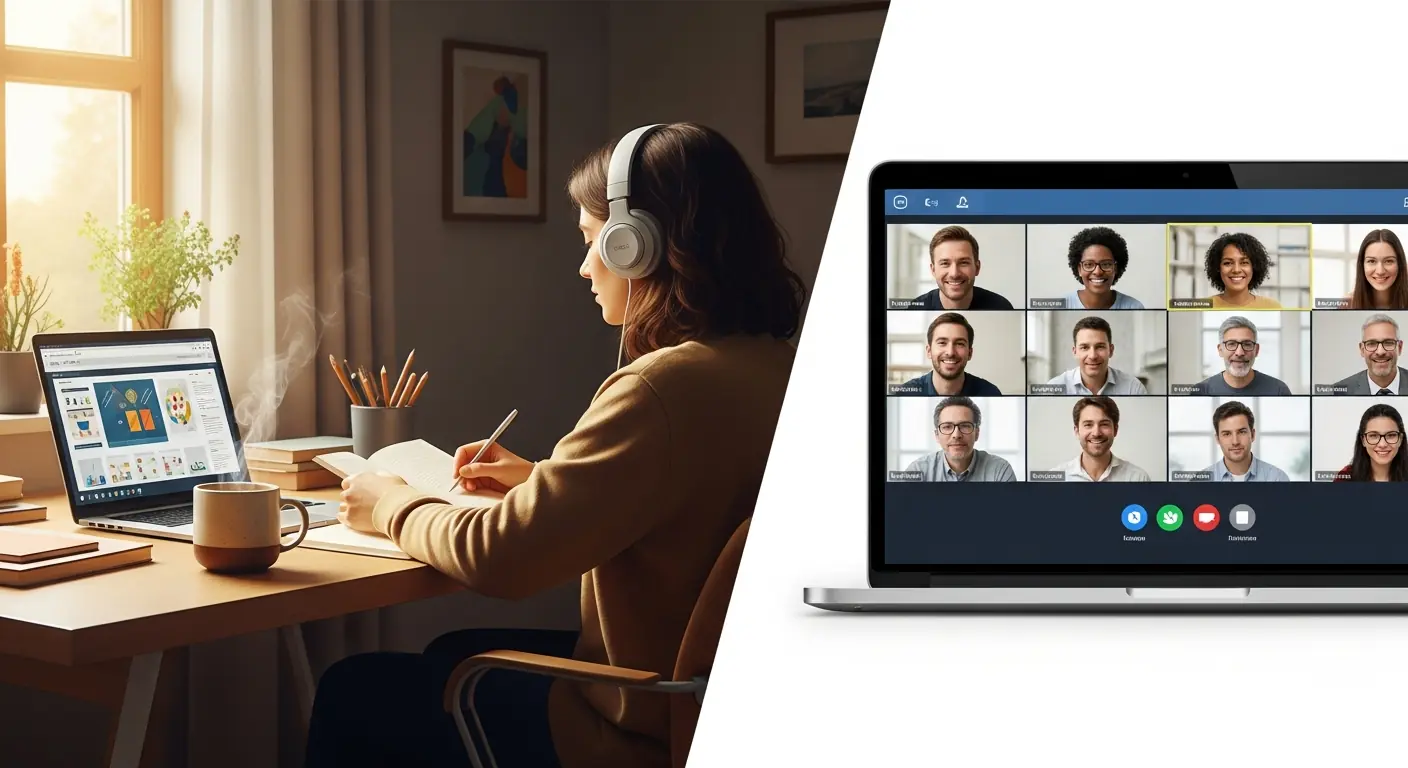
The Battle of Formats: Live Zoom or Video Recording?
In the past, things were clear: if you wanted to study, you had to be in the lecture hall at 8:00 AM. Today, you have a choice. The e-learning market is increasingly splitting into two areas:
- Synchronous Learning (Instructor-Led): Live webinars, Zoom calls, virtual classrooms
- Asynchronous Learning (Self-Paced): Pre-recorded videos, forums, e-books, interactive scripts
Market analyses differ on the details: Global Market Insights (2026) puts self-paced e-learning at USD 147.5 billion in 2025, more than half of the market it measures. Grand View Research (2026) sees instructor-led virtual courses ahead in the e-learning services market, but expects self-paced courses to grow fastest through 2033.
The reason? Flexibility. Many students value recordings because they can pause, rewind, and adjust the speed (1.5x). Studies show, however, that most students use recordings as a supplement, for example to catch up on missed lectures or to prepare for exams, rather than as a replacement for live teaching (Gorissen et al., 2012; Simcock et al., 2017).
Flipped Classroom: Why You Shouldn't "Attend" Lectures Anymore
A model that has spread at universities worldwide is the Flipped Classroom (inverted classroom).
Old model: Listen in university (passive), do exercises at home (active/difficult)
New model (Async first): Watch videos at home (absorb knowledge), solve exercises in university/Zoom (test understanding)
Studies show that this model can improve learning outcomes slightly: a meta-analysis of 114 studies (van Alten et al., 2019) found a small positive effect, but no effect on student satisfaction. Why? Because you learn complex theories at your own pace ("Asynchronous"), but can ask the instructor live when you have problems ("Synchronous").
Decision Guide: Which Learning Type Are You?
Not every format suits everyone. Here's a guide:
Choose Asynchronous When:
- You're absorbing new, complex content for the first time
- You have a variable daily schedule (job, family, commute)
- You're a deep processor who needs time to think
- You want to control the pace (pause, rewind, speed up)
- You prefer to learn during your personal peak hours
Choose Synchronous When:
- You need direct feedback on questions
- You're working on group projects or discussions
- You want networking and exchange with fellow students
- You're practicing soft skills (presentation, negotiation)
- You need accountability and external structure
The Best of Both Worlds: Hybrid Learning
The smartest approach isn't either/or; it's knowing when to use what:
- Theory = Async: Watch lectures at 1.5x speed, pause for notes
- Application = Sync: Discuss problems live, get immediate help
- Review = Async: Re-watch difficult sections as often as needed
- Collaboration = Sync: Work on projects together in real-time
What the Numbers Say
According to Grand View Research (2026), self-paced courses are the fastest-growing segment of the e-learning services market through 2033. Global Market Insights (2026), by contrast, expects the share of self-paced e-learning to fall to 50% by 2035, while instructor-led online training grows by 13.4% a year.
A meta-analysis of 56 studies (Rey et al., 2019) found that learners remember and apply content somewhat better when material is presented in segments rather than as one continuous stream (small to medium effects).
Active learning in class, the core of the flipped classroom, raised average exam scores by about 6% in a meta-analysis of 225 studies in STEM subjects (Freeman et al., 2014), and students in traditional lectures were 1.5 times more likely to fail.
Practical Tips for Your Studies
- Check your schedule: Does your program offer recordings? Use them!
- Identify your peak hours: When do you learn best? Schedule async learning then
- Reserve sync for interaction: Don't waste live sessions on passive listening
- Use playback speed: 1.25x or 1.5x saves hours over a semester: with 100 hours of lecture material, about 20 hours at 1.25x and about 33 hours at 1.5x
- Create your own mix: Combine async content with sync study groups
Conclusion
The question is no longer "online or offline"; it's "async or sync." Understanding when to skip the livestream and when to show up live is a skill that will make your studies more efficient and more enjoyable. The future belongs to those who master both formats.
Sources
Information as of: 12 October 2026
- E-Learning Market Size and Share 2026-2035 (Report GMI215, September 2026), Global Market Insights, accessed on 16 October 2026
- E-learning Services Market (2026-2033) Size, Share and Trends Analysis Report, Grand View Research, accessed on 16 October 2026
- Students and recorded lectures: survey on current use and demands for higher education (Gorissen et al., 2012), Research in Learning Technology (Association for Learning Technology), accessed on 16 October 2026
- A survey of first-year biology student opinions regarding live lectures and recorded lectures as learning tools (Simcock et al., 2017), Advances in Physiology Education, über James Cook University ResearchOnline, accessed on 16 October 2026
- Active learning increases student performance in science, engineering, and mathematics (Freeman et al., 2014), PNAS, über PubMed Central (NIH), accessed on 16 October 2026
- 114 studies on flipped classrooms show small payoff for big effort (on van Alten et al., 2019), The Hechinger Report, accessed on 16 October 2026
- A Meta-analysis of the Segmenting Effect (Rey et al., 2019), Educational Psychology Review (Springer), accessed on 16 October 2026
This content was created with the help of AI, mainly for research and first drafts. Reviewed and approved by our editorial team.
About the Author

Ramon Tissler
Founder & CEO
Ramon Tissler is the founder and CEO of StudyOnline.now. With over 25 years of experience in the education sector, he previously founded and led College Contact (1998-2020), a German education agency for international study programmes. His mission is to make finding the right online degree simpler, faster, and more accessible than ever before.